Feedback as a Living Food Safety Mechanism
- May 20, 2026
- Posted by: Thanasis Stathopoulos
- Category: Industrial

How the System Works: In Food Safety, Management Systems do not typically fail because procedures are missing. They fail when procedures stop conversing with the actual operation of the factory. And one of the points where this conversation either lives or dies is feedback.
Feedback is not a “communication channel” that exists for the sake of design completeness. It is the way an FSMS checks whether it is still functioning as intended. Whether its assumptions still hold. Whether the hazards it anticipated are appearing in the same form, with the same intensity and at the same frequency. Without feedback, the system keeps running — but it runs blind.
In practice, feedback in Food Safety takes many forms. It is the observations of staff about deviations that do not yet have a “name.” It is the recurring small problems that get patched over so that production can continue. It is the near misses that go unrecorded because “nothing actually happened.” It is even silence — when people stop speaking up because they believe nothing will change. It also has a broader dimension: the Food Safety Climate of an organisation, which gives us a picture of how employees feel about Food Safety, how they receive it and how they perceive it in their daily work.
The value of feedback is constructed at the point of collection, but it resides primarily in what comes after. If the information is not genuine, if it is not analyzed, if it is not discussed, if it does not return to the system in the form of change — then it does not function as a safety mechanism. It functions merely as a record. Without feedback, the system loses opportunities for improvement and innovation.
Here, the availability of managers and supervisors plays a decisive role. Feedback does not “travel upward” on its own. It requires people who are present, accessible, willing to listen without defensiveness and without immediately looking for someone to blame. When staff perceive that management or QA is distant, busy or only formally present, feedback is filtered before it is even spoken.
Equally critical is regularity. Feedback cannot rely on exceptional moments or annual reviews. When it is collected sporadically, it loses its momentum. By contrast, when it is built into stable cycles — conversations, brief reviews, structured experience-sharing sessions and similar practices — it ceases to be an “intervention” and becomes part of normal operations.
In mature FSMS, feedback does not stop at observation. It frequently becomes training material. A recurring theme from the floor can become a short training session. A misunderstanding of a procedure can lead to its redesign. In this way, experience is not lost — it is transformed into learning and continuous feedback to the organization and its people at every level.
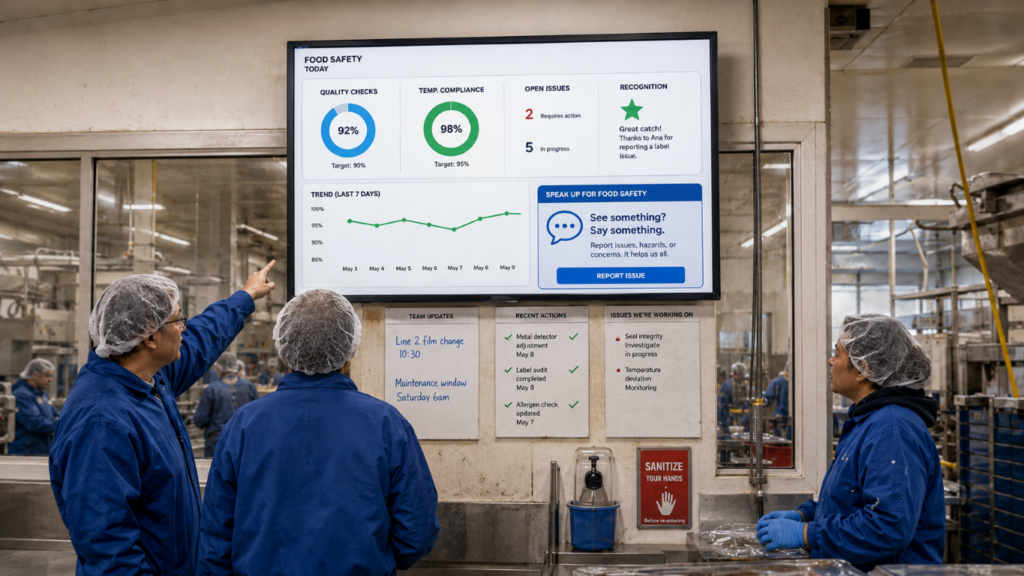
In recent years, modern parallel tools have emerged to reinforce this mechanism. Closed feedback platforms — anonymous or named — structured digital communication flows, tools that allow staff to speak without fear of immediate exposure. These approaches do not replace physical presence and dialogue, but they work alongside it, particularly in large or multi-layered organizations.
Initiatives such as Social Food’s Feedback from Below — a live feedback training session within the Industrial Maturity Path — and digital dialogue and safety tools such as TalkSafe, developed by Complago, belong in this context. The common thread running through these tools is not the technology itself, but the intention: to ensure that information from the floor finds its way into the system and returns as improvement.
Current events remind us, in the hardest possible way, that serious incidents do not appear suddenly within an otherwise “healthy” system. They are preceded by periods in which small signals, experiences and observations fail to be transformed into collective knowledge and timely adaptation. It is precisely there that the true resilience of a Food Safety System is put to the test.


