Historicizing the Assembly Line
- May 21, 2026
- Posted by: Thanasis Stathopoulos
- Category: Social
What can the history of the assembly line teach the modern food industry? This article explores how innovation, experimentation, cultural adaptation, and continuous improvement shaped industrial production systems — and why the transition toward sustainable food production may require the same mindset today. Drawing on David E. Nye’s America’s Assembly Line, it connects historical industrial transformation with the future challenges of Food Safety Culture and sustainability.
The Unplanned Emergence of the Assembly Line
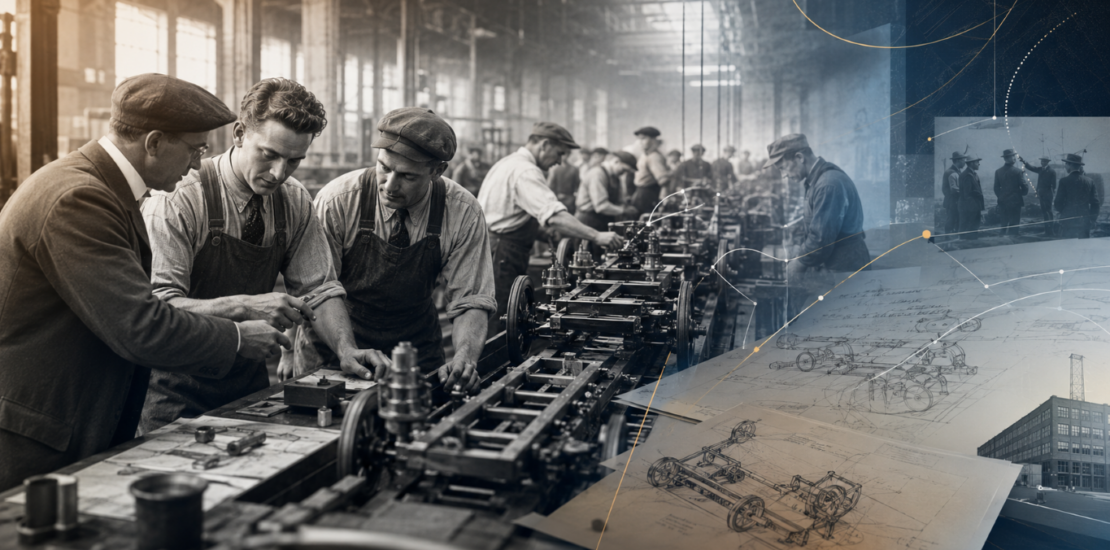
One of Nye’s most important arguments is that the assembly line was not invented — it emerged. There was no master plan, no research programme, no blueprint drawn up in advance. What existed at Ford’s Highland Park plant in 1913 was a dynamic, experimental environment populated by people from diverse technical backgrounds who were given space and resources to try things. The moving line, the subdivision of labour, the sequencing of machines, the electrification of the factory — none of these elements was novel in isolation. What was novel was their combination, and that combination arose through a process of continuous tinkering, feedback, and incremental adjustment that no one fully understood until it was already working.
Nye is explicit about this: as he writes, “the history of the assembly line, both its invention and reinvention, suggests that fundamental transformations are unpredictable. They can emerge unexpectedly when talented people are given time, resources, and opportunities to experiment” (Nye, 2013). The same principle, he argues, applied to Toyota’s development of lean production in the 1950s. The engineers involved had no systemic vision of what they were creating. They were solving immediate problems, and a radically more efficient production system emerged as an unintended consequence of that problem-solving.
For industries thinking about transformation today — including food — this is a significant observation. It suggests that the conditions for major innovation are less about having a clear destination and more about creating the organisational environments where experimentation, cross-disciplinary collaboration, and tolerance for failure are genuinely possible. The assembly line was not the product of a five-year roadmap. It was the product of a company culture that, at a particular historical moment, actively encouraged its people to challenge existing practice.
Challenges in Technology Transfer and the Impact of Cultural Context
A substantial part of Nye’s analysis is devoted to the difficulties of exporting the assembly line. Ford and General Motors invested heavily in European expansion from the 1910s onwards, and European manufacturers repeatedly sent delegations to Detroit to study American methods. The transfer was slow, partial, and frequently unsuccessful. British workers demanded more autonomy on the factory floor. French consumers wanted vehicle variety that the rigid assembly line could not easily accommodate. German manufacturers resisted the deskilling of labour. Protectionist tariffs fragmented the European market in ways that prevented the economies of scale on which the assembly line depended.
The conclusion Nye draws is that technology transfer is never merely a technical transaction. Any production system is embedded in a specific cultural, economic, and social context, and extracting it from that context and transplanting it elsewhere always involves friction. This was as true of the transfer of lean production methods from Japan to the United States in the 1970s and 1980s as it was of Fordism moving to Europe in the 1920s. American manufacturers spent more than two decades trying to adopt Japanese methods selectively — taking elements they found convenient while resisting the comprehensive cultural and organisational changes that made those methods work in Japan. The result was, for a long time, failure.
For the global food industry, this argument is immediately recognisable. Food production systems, processing technologies, and quality management frameworks developed in one context — whether industrial breadmaking, dairy processing, or large-scale vegetable production — do not transfer cleanly to different cultural and agricultural environments. Consumer expectations, regulatory frameworks, labour practices, ingredient supply chains, and even the physical infrastructure of food distribution vary enormously across markets. Nye’s history suggests that food businesses approaching new markets or attempting to implement new production systems need to treat cultural adaptation not as a peripheral concern but as a central design challenge.
Evolving the Assembly Line: From Historical Foundations to Future Sustainability
Nye traces the assembly line through a long arc of transformation. The classic Ford line of 1913 — rigidly optimised for a single, identical product — gave way over decades to more flexible systems capable of handling variety. Japanese lean production eliminated waste, reduced inventory, and engaged workers in continuous improvement in ways that the classic Fordist model had never attempted. Computerisation and robotics further transformed the shop floor. By the time Nye visited the Ford Focus plant in Michigan in 2011, the assembly line bore only a family resemblance to what had been invented a century earlier. Robots performed the welding. Software tracked every part from delivery to installation. The floor itself moved, automatically adjusting the height of each vehicle for the worker at each station. And a single line produced multiple models with hundreds of thousands of possible variations.
What remained constant across all these transformations was the underlying logic: subdivide work, sequence operations, eliminate bottlenecks, reduce waste, and continuously improve throughput. What changed were the means by which this logic was pursued, and the values that were brought to bear on it. Lean production introduced a new value — respect for worker knowledge — that the classic assembly line had systematically suppressed. Computerisation introduced a new capability — real-time tracking and quality control — that radically changed the relationship between the production process and the information needed to manage it.
Nye’s history suggests that no version of the assembly line has ever been final. Each major reinvention has been driven by a combination of competitive pressure, new technology, and a shift in the values brought to production. The current moment — defined by climate pressure, resource constraints, and regulatory expectations around sustainability — represents another such inflection point.
Transforming the Assembly Line for Sustainability
Nye’s final chapter confronts the question directly: can the assembly line, which has driven a century of accelerating consumption and resource use, become part of a genuinely sustainable production system? His answer is cautiously affirmative, but only if the transformation goes well beyond green marketing and incremental efficiency improvements.
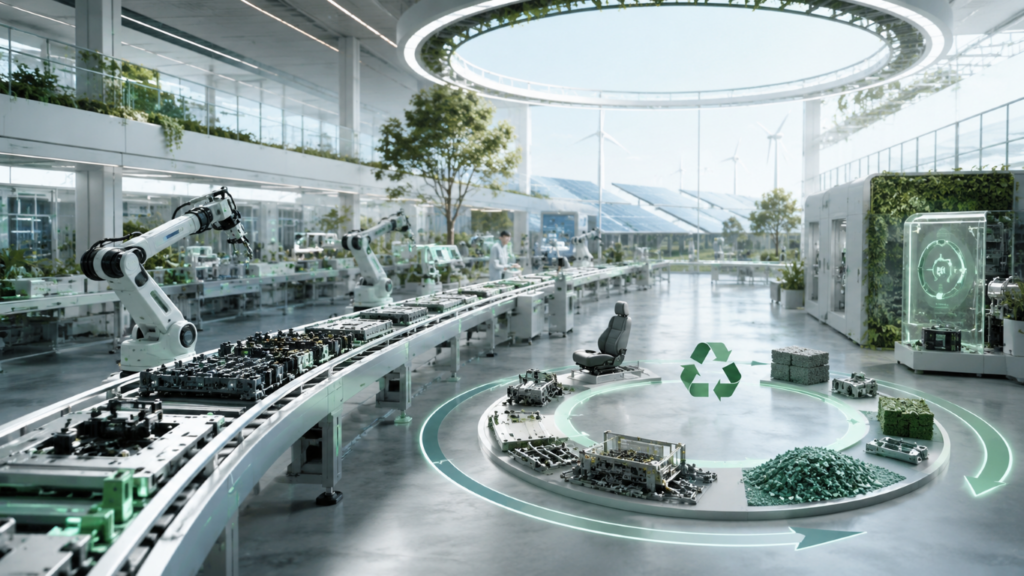
He draws on the work of architect William McDonough, whose concept of “cradle to cradle” production reimagines every factory as part of a closed-loop material system — what McDonough calls a “technical metabolism” — in which materials circulate continuously between production, use, recovery, and remanufacture, powered by renewable energy and designed from the outset for disassembly and reuse. This is not an add-on to existing assembly-line logic. It requires redesigning products, production processes, supply chains, and consumption patterns simultaneously.
Nye is clear that the food industry is one of the systems most urgently requiring this kind of transformation. Food production sits at the intersection of energy use, water consumption, land management, biodiversity, waste generation, and public health in ways that make the sustainability challenge uniquely complex. The assembly-line logic that has driven food industrialisation — standardisation, subdivision, throughput optimisation — has delivered cheap, abundant food at enormous environmental cost. Reversing that cost while maintaining the productive capacity that feeds a global population is precisely the kind of challenge that, in Nye’s framework, will not be solved by planning alone. It will require the same conditions that produced the assembly line in the first place: diverse expertise, genuine experimentation, tolerance for failure, and institutional environments that reward transformation over the defense of existing practice.
The history of the assembly line does not offer a blueprint for that transformation. But it offers something arguably more useful: a clear account of how fundamental change has actually happened before, and what conditions made it possible.
References
- David E. Nye (2013), America’s Assembly Line (Cambridge: MIT Press)


