Food Labelling as Science Communication (Health and Nutrition) – Insights from Science and Technology Studies
- May 20, 2026
- Posted by: Thanasis Stathopoulos
- Category: Social
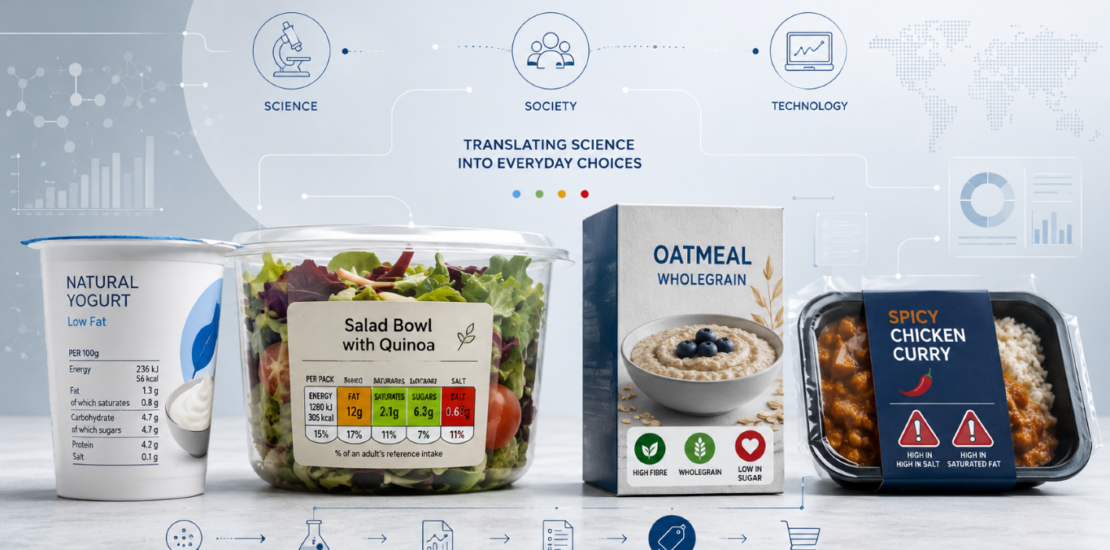
Food labels are among the most ordinary objects in a consumer’s daily life. And yet, behind this apparently simple communicative act lies a complex epistemological and design problem: how is scientific knowledge translated into meaningful messages for a broad, heterogeneous audience? This is precisely the question that the literature on Science Communication and Science and Technology Studies (STS) has begun to frame in ways the food industry has not yet fully absorbed.
Science Communication as a Framework
Burns, O’Connor and Stocklmayer (2003) define Science Communication as the use of appropriate skills, media, activities and dialogue to produce personal responses to science — what they call the AEIOU framework: Awareness, Enjoyment, Interest, Opinion-forming, and Understanding. What matters about this definition is that it evaluates communication by its outcomes in the recipient, not by the intentions of the sender. A warning label that triggers avoidance behaviour has produced awareness and possibly an opinion. It has not necessarily produced understanding. Whether understanding is always the goal — or whether a clear behavioural nudge is sometimes sufficient — is a question with direct implications for label design.
Burns et al. also identify a persistent paradox: high public interest in science alongside low measurable comprehension. They trace this to the deficit model — the assumption that the public simply lacks knowledge and that the solution is to supply more information. This model misreads the problem. Communication is not a pipeline. The contextual model they favour instead treats it as a two-way street, in which local knowledge, values and context shape how scientific information is received. This reframing is not abstract for the food sector. It explains why nutritionally superior products fail to be chosen, why clear labelling is ignored, and why technically accurate health claims can nonetheless mislead.
The Shifting Landscape: Science Communication 2.0
Massimiano Bucchi (EFSA Journal, 2019) describes a “crisis of mediators” in which new research reaches the public in real time, unfiltered by journalists or institutional gatekeepers. Scientists debate on social media. Consumers access primary research directly. The boundary between expert and non-expert has become, in his words, “fluid and porous.” For the food industry, this means that nutritional claims and health warnings now compete with influencer content, contested studies, and retracted papers. The authority of a nutrition label can no longer be taken for granted. It must be designed, earned, and contextualised.
Bucchi and Trench (2021) deepen this by identifying two challenges that are directly relevant here. First, the fragmentation of publics: different consumers bring different assumptions, different levels of prior knowledge, and different relationships to food and health. A labelling system designed for one segment will almost certainly fail another. Second, the collapse of communication contexts: controversies once confined to peer-reviewed journals now unfold in public view. For food science, which is particularly prone to contested findings and industry-funded research disputes, the communicative context in which a nutrition label is received is permanently charged with skepticism.

What the Research Shows
Kate Scott’s 2023 article in Frontiers in Communication provides a valuable empirical anchor. Applying relevance theory to front-of-pack labelling, she compares three systems: non-directive Facts Up Front labels, semi-directive traffic light systems, and directive warning labels. The findings are consistent across multiple systematic reviews: semi-directive systems outperform non-directive ones, and warning labels are most effective for identifying products to be avoided.
Scott’s explanation is precise. Cognitive relevance — the degree to which information produces useful cognitive effects relative to the processing effort it requires — determines how effectively a label communicates. Facts Up Front systems demand numerical literacy, familiarity with recommended daily amounts, and the ability to calculate what those numbers mean for a purchase decision. Warning labels require almost no prior knowledge. A warning sign activates pre-existing associations with danger and avoidance. The inferential path from label to decision is short. More information is not the same as more relevance.
Scott also identifies a key limitation: warning labels are effective at triggering avoidance, but they do not improve nutritional knowledge or guide consumers toward healthier alternatives. They work where consumers are ambivalent. Where consumers already know a product is unhealthy, the label produces no new cognitive effect. This is a precise and useful finding for anyone thinking about where labelling can and cannot do meaningful communicative work.
The Food Industry
Burns et al. observed that “surveys suggest that the public does not know much about science, and it appears that scientists don’t know much about the public.” The food industry communicates science every time it prints a label. Whether that communication produces awareness, understanding, or a meaningful change in behaviour depends on decisions that are rarely framed as communicative decisions: how information is structured, what assumptions the consumer is expected to bring, how many inferential steps lie between the label and the choice. Getting those decisions right requires not only food science and design expertise, but a genuine engagement with the social and communicative conditions in which food choices are actually made.
References
- William Paisley, (1998). “Scientific literacy and the competition for public attention and understanding,” Science Communication 20, no. 1 (1998): 70–80.
- Chris Bryant, (2002). “Does Australia need a more effective policy of Science Communication?,” International Journal of Parasitology in press (2002): 7.
- Burns, T. W., O’Connor, D. J., & Stocklmayer, S. M. (2003). Science Communication: A Contemporary Definition. Public Understanding of Science, 12(2), 183–202. https://doi.org/10.1177/09636625030122004
- Hojoon Choi & Jeffrey K. Springston (2014). How to Use Health and Nutrition–Related Claims Correctly on Food Advertising: Comparison of Benefit-Seeking, Risk- Avoidance, and Taste Appeals on Different Food Categories, Journal of Health Communication:International Perspectives, 19:9, 1047-1063, DOI: 10.1080/10810730.2013.872723
- Bucchi, M. (2019). Facing the challenges of science communication 2.0: quality, credibility and expertise. EFSA Journal, 17. https://doi.org/10.2903/j.efsa.2019.e170702
- Bucchi, M., & Trench, B. (Eds.). (2021). Routledge Handbook of Public Communication of Science and Technology (3rd ed.). Routledge. https://doi.org/10.4324/9781003039242
- Scott K (2023), Nutritional labeling, communication design, and relevance. Front. Commun. 8:1125575. doi: 10.3389/fcomm.2023.1125575

- Growth through innovation/creativity:
Rather than be constrained by ideas for new products, services and new markets coming from just a few people, a Thinking Corporation can tap into the employees. - Increased profits:
The corporation will experience an increase in profits due to savings in operating costs as well as sales from new products, services and ventures.
- Higher business values:
The link between profits and business value means that the moment a corporation creates a new sustainable level of profit, the business value is adjusted accordingly. - Lower staff turnover:
This, combined with the culture that must exist for innovation and creativity to flourish, means that new employees will be attracted to the organization.
Leave a Reply Cancel reply
If the challenges discussed in this article reflect situations within your organization, a structured discussion can be the next step.
-
From the Ship’s Hold to the Tin Can
A Greek manual from 1907 reveals how prevention, measurement, and practical knowledge were already shaping food safety at sea.
August 18, 2026Read More -
When Fixing Things Was the Norm: What the History of Repair Tells Us About Food Production
What does the history of repair reveal about modern food production? Drawing on recent historical research, this article explores how repair, maintenance, and hands-on technical knowledge once formed the foundation of productive systems — and why these ideas are becoming increasingly relevant again in discussions around sustainability, equipment management, resilience, and industrial Food Safety Culture.
May 22, 2026Read More -
Historicizing the Assembly Line
What can the history of the assembly line teach the modern food industry? This article explores how innovation, experimentation, cultural adaptation, and continuous improvement shaped industrial production systems — and why the transition toward sustainable food production may require the same mindset today. Drawing on David E. Nye’s America’s Assembly Line, it connects historical industrial transformation with the future challenges of Food Safety Culture and sustainability.
May 21, 2026Read More

