When Fixing Things Was the Norm: What the History of Repair Tells Us About Food Production
- May 22, 2026
- Posted by: Thanasis Stathopoulos
- Category: Social
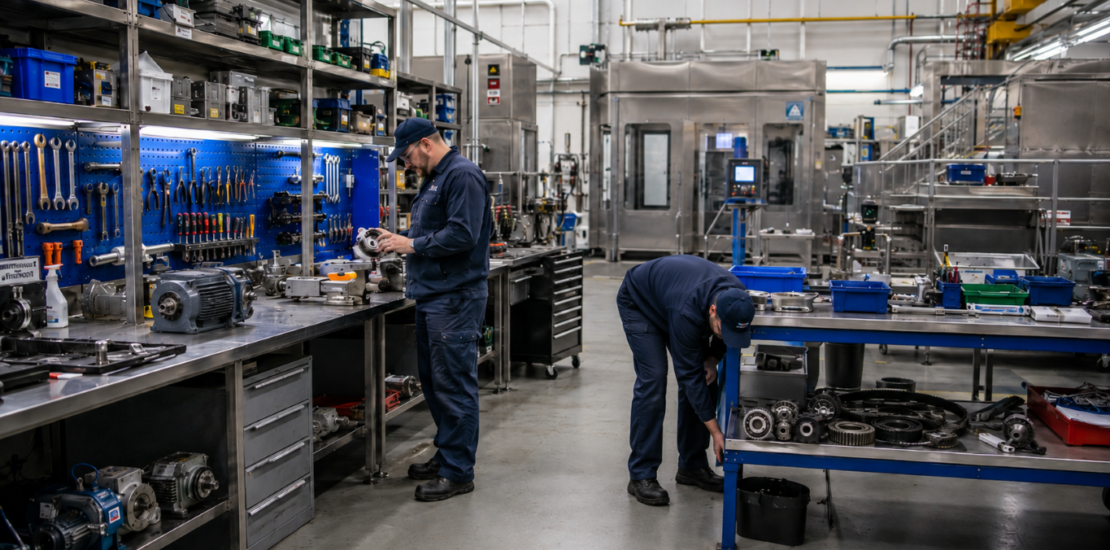
A recent academic article by historians Bernasconi, Carnino, Hilaire-Pérez, and Raveux, published in Technology and Culture (2024), makes a compelling case that repair has been one of the most underestimated forces shaping human technical culture across history. The authors argue that modern Western society has come to treat repair as an exception — something you do reluctantly when an object breaks — while in reality, for most of human history and across most cultures, maintaining, adapting, and repairing objects was the rule, not the exception.
This argument carries direct relevance for food industry professionals thinking about production tools, equipment maintenance, circular economy practices, and the relationship between craft knowledge and industrial efficiency.
Repair Was Never Just About Poverty or Scarcity
One of the article’s most striking arguments is that repair has historically been associated not with poverty or failure, but with skill, virtue, and economic intelligence. The authors draw on evidence ranging from medieval manuscripts and Bronze Age metalwork to 18th-century European workshops, showing that across vastly different societies, maintaining and repairing objects was a mark of competence and good management — not a last resort.
In the context of food production, this is a perspective worth sitting with. The pressure to replace rather than repair equipment, to upgrade rather than maintain, is often framed as progress. The article invites us to question that framing. In pre-industrial food processing environments, worn tools were frequently better tools: the authors cite the example of sugar molds that became smoother and more effective after repeated repairs, making them more desirable to sugar makers precisely because of their use history. The idea that a repaired or worn object is automatically inferior to a new one is, the article suggests, a relatively recent and culturally specific assumption.
Repair as a Generator of Knowledge and Skill
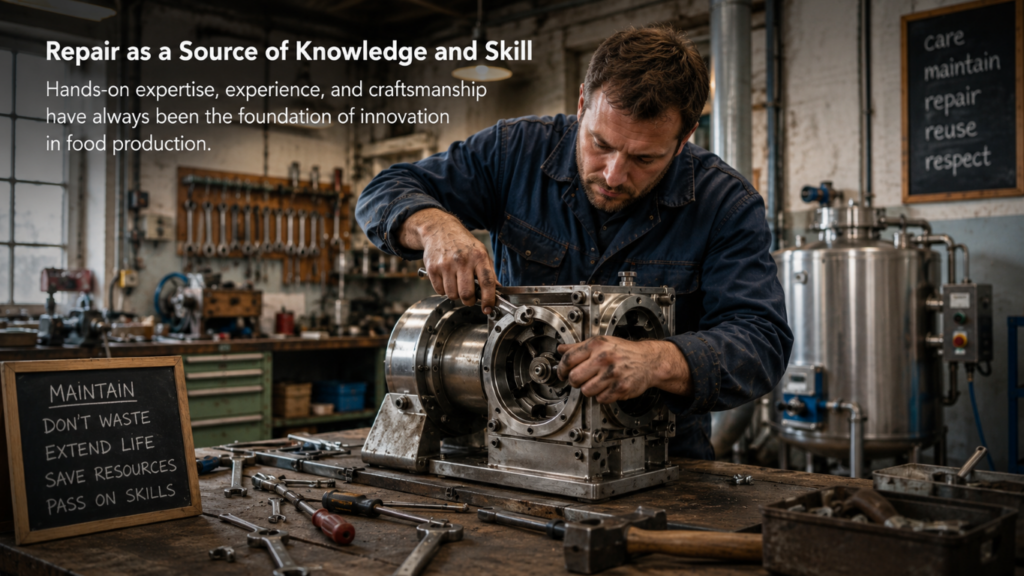
The article argues that repair practices have historically been one of the primary ways in which technical knowledge was created, transmitted, and refined. Craftsmen who repaired objects developed deep familiarity with materials, processes, and failure modes that no manual or guideline could fully capture. This kind of embodied, hands-on knowledge — what the authors call savoir-faire — was the backbone of pre-industrial production cultures.
For food industry professionals, this maps directly onto a recurring tension in modern food manufacturing: the gradual erosion of craft knowledge as production becomes more automated and standardized. When a technician understands a machine deeply enough to repair it, they understand it in a fundamentally different way than someone who can only operate it. The article makes the case that this kind of knowledge is not a quaint relic but a genuine form of technical intelligence that has driven innovation across centuries.
The Circular Economy Is Not a New Idea
The authors position their historical analysis explicitly within current debates about sustainability and the circular economy. They argue that what contemporary sustainability advocates promote as a new paradigm — keeping materials in use longer, reducing waste, designing for repairability — was simply the default logic of economic life for most of human history. The throwaway culture is the anomaly, not the norm.
For food businesses navigating regulatory pressure and consumer demand around sustainability, this historical framing offers both perspective and legitimacy. Practices like extending the life of processing equipment, reusing packaging components, or building maintenance into production cycles are not concessions to an external agenda — they are a return to the operational logic that defined skilled food production for centuries.
The Political Dimension of Repair
One of the more thought-provoking sections of the article examines how different political and economic systems have treated repair very differently. The authors note that while Western consumer capitalism actively discouraged repair through planned obsolescence and the design of products that were difficult or impossible to fix, the communist bloc built repair into the fabric of its economy and educational system. Meanwhile, in post-colonial contexts across Africa and Latin America, repair cultures have operated as forms of both practical resilience and political assertion — ways of reclaiming technical agency in systems designed to create dependency.
The food industry operates within these same dynamics, often without naming them. Who controls the knowledge required to maintain and repair food production equipment? Who has access to spare parts, technical documentation, and the expertise to keep aging infrastructure operational? The article suggests these are not merely logistical questions but questions about power, autonomy, and the distribution of technical knowledge.
What Happens When Repair Becomes Impossible
The article closes with a genuinely unsettling observation about the digital era. As technology becomes more complex and miniaturized, the possibility of meaningful human intervention — of understanding, maintaining, and repairing the tools we depend on — diminishes. The authors cite the example of African mechanics who can restore almost any mechanical component of a vehicle but must first strip out all electronic systems before they can work on it. The electronics are simply beyond the reach of human repair.
Food production technology is moving rapidly in the same direction. The increasing integration of sensors, software, and proprietary systems into food processing equipment raises real questions about who can maintain these systems, what happens when they fail, and whether the deep craft knowledge that once resided in experienced production staff has any place in the modern factory. The article does not offer easy answers, but it asks the right questions.
A Lens Worth Using
Bernasconi and colleagues did not write their article for food industry professionals. But the argument they develop — that repair is a window into how societies organize knowledge, value materials, and distribute technical power — is directly applicable to anyone working in food production today. At a moment when the industry faces simultaneous pressure around sustainability, supply chain resilience, equipment costs, and the preservation of craft knowledge, the history of repair turns out to be surprisingly current.
References
- Bernasconi, G., Carnino, G., Hilaire-Pérez, L., & Raveux, O. (2024). Debate: (Re)thinking repairs in the longue durée. Technology and Culture, 65(3), 761–789


