Beyond R&D: What Innovation Policy Theory Tells the Food Industry About the Limits of “More Science”
- May 20, 2026
- Posted by: Thanasis Stathopoulos
- Category: Social
A 2018 article by Johan Schot and W. Edward Steinmueller, published in Research Policy, argues that the way governments and industries think about innovation has been shaped by a small number of persistent mental frameworks — and that these frameworks are no longer adequate to address the social and environmental challenges of our time. The article identifies three distinct “frames” for innovation policy, traces their historical origins, and makes the case that a third, largely underdeveloped frame is the one most urgently needed today. Though the article is addressed to policymakers and academics, its core arguments are directly applicable to food industry professionals navigating sustainability pressures, regulatory change, and the growing gap between technological investment and real-world impact.
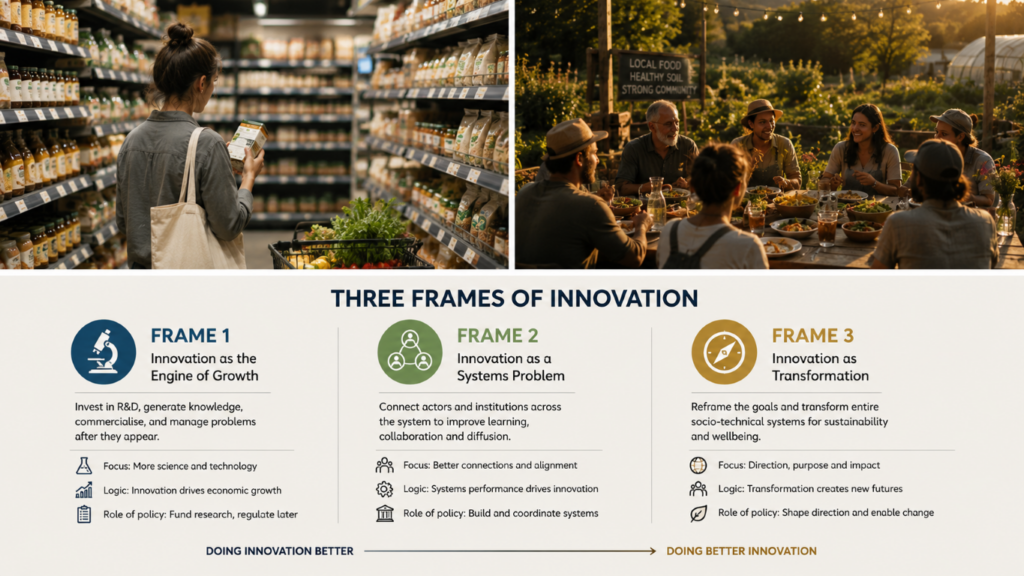
Frame 1: Innovation as the Engine of Growth
The first frame, according to the article, emerged after World War II and rests on a straightforward premise: public investment in science and R&D produces knowledge, knowledge produces innovation, and innovation produces economic growth. Under this frame, the role of government is to fund basic research and regulate problems after they appear. The role of industry is to commercialise scientific discoveries. The assumption is that negative consequences — environmental damage, health risks, social disruption — can be managed through regulation once they become visible.
The food industry has operated largely within this frame for decades. Investment in food science, ingredient technology, processing efficiency, and packaging innovation has been treated as inherently progressive — a driver of productivity, safety, and consumer choice. Regulation, in this model, arrives after the fact: a new additive is approved, a contaminant threshold is set, a labelling requirement is introduced. The article does not dismiss this approach, but it does expose its structural limitation: it assumes that the direction of innovation is essentially neutral, and that any problems it generates can be corrected downstream. The history of food-related controversies — from trans fats to endocrine-disrupting packaging materials to ultra-processed food formulations — suggests this assumption deserves scrutiny.
Frame 2: Innovation as a Systems Problem
The second frame emerged in the 1980s in response to the growing recognition that R&D investment alone did not explain differences in innovative performance between countries. Japan’s industrial rise, in particular, prompted researchers to look beyond laboratories and ask how knowledge moves through economies — how firms learn from suppliers and customers, how universities connect to industry, how regional clusters develop shared capabilities. The concept of national systems of innovation captured this insight: what matters is not just how much a country invests in research, but how well the different actors in its innovation system are connected and aligned.
For the food industry, this frame maps onto the growing emphasis on supply chain integration, public-private research partnerships, cluster development in agri-food regions, and the knowledge-sharing networks that link food companies, ingredient suppliers, research institutes, and regulatory bodies. It also maps onto the Triple Helix logic that has shaped food innovation policy in many countries, where universities, industry, and government are expected to collaborate on shared research agendas. The article’s contribution here is to point out that this systems approach, while more sophisticated than simple R&D investment, still shares the first frame’s fundamental assumption: that more and better-connected innovation is inherently beneficial, and that social and environmental goals can be addressed separately, through redistribution and regulation, once growth has been achieved.
Frame 3: Innovation as Transformation
The third frame is where the article makes its most provocative and consequential argument. The authors contend that neither Frame 1 nor Frame 2 is adequate to address challenges like climate change, inequality, resource depletion, and the sustainability of food systems — not because they are wrong, but because they are built around the wrong question. Both frames ask how to produce more and better innovation. Frame 3 asks what kind of innovation, in what direction, serving what social and environmental purposes.
The article describes this as transformative change — not the replacement of one technology with another, but the restructuring of entire socio-technical systems. The example the authors use is mobility: replacing petrol cars with electric cars is a Frame 1 or Frame 2 response. Restructuring the entire system of how people move — reducing car dependency, integrating public transport, cycling, shared mobility services, and urban planning — is a Frame 3 response. The difference is not incremental; it is systemic.
The food industry is one of the most explicit examples the article cites as requiring this kind of systemic transformation. Food production, processing, distribution, and consumption are deeply embedded in patterns of resource use, land management, logistics infrastructure, cultural practice, and regulatory convention that cannot be addressed by developing new ingredients or improving processing efficiency. The article argues that genuinely transformative food system change requires opening up the question of direction — not just asking how to produce food more efficiently, but asking what food systems should produce, for whom, at what environmental cost, and governed by what principles.
What This Means in Practice
The article identifies four types of failure that transformative innovation policy must address, each of which has direct relevance for food businesses and food policy professionals.
The first is directionality failure — the absence of meaningful social processes for choosing between different development pathways. In food, this is the gap between what the industry knows how to optimize and what society actually needs from its food system. Filling this gap requires deliberation, not just market signals or regulatory compliance.
The second is policy coordination failure — the inability of different government agencies and policy domains to align around a shared transformative agenda. Food policy sits at the intersection of agriculture, health, environment, trade, and consumer protection, each governed by separate bodies with separate mandates. The article argues that transformation requires a whole-of-government approach, with the caveat that such approaches are vulnerable to capture by incumbent interests.
The third is demand articulation failure — the difficulty of giving voice to the preferences and needs of future users, marginalised consumers, and communities who are not currently well-served by existing food systems. This is not simply a market research problem. It requires active processes of engagement, participation, and co-design.
The fourth is reflexivity failure — the inability of actors within a system to question their own assumptions about what they are doing and why. For food industry professionals, this is perhaps the most challenging of the four. It requires asking not just how to do what the industry already does more sustainably, but whether the current direction of food system innovation is producing the outcomes that a sustainable and equitable food system requires.
The Scientist Who Doesn't Understand Society — and the Society That Doesn't Understand the Scientist
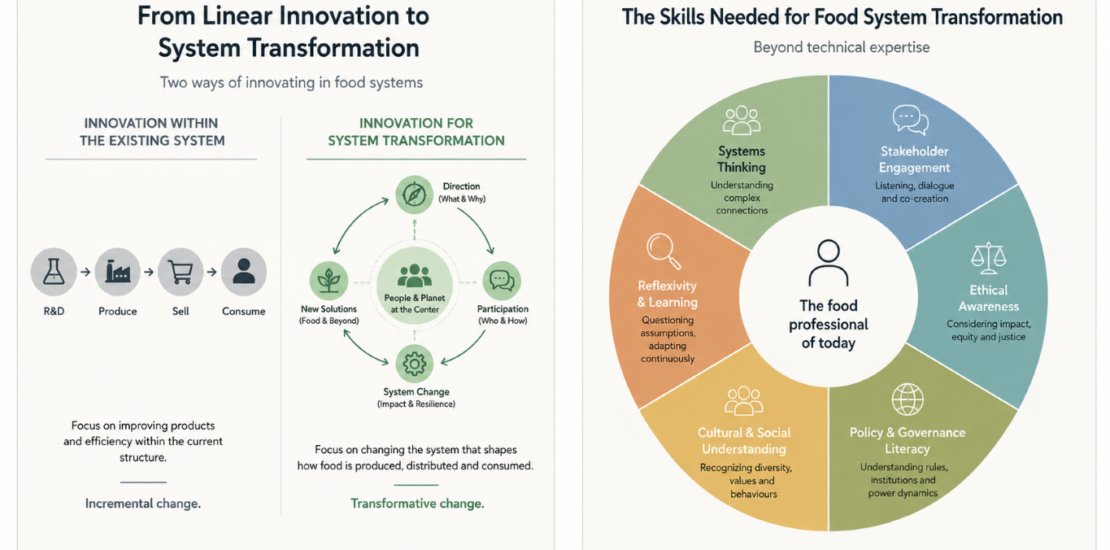
One of the article’s more pointed observations concerns education and the skills of the researchers and professionals who are expected to drive innovation. Schot and Steinmueller argue explicitly that the knowledge base required for transformative change cannot be dominated by economics and technical disciplines alone. It must draw on sustainability transitions research, science and technology studies, governance, history of technology, and development studies. More practically, it requires individuals capable of bridging the social sciences and the STEM fields — people who can connect what is technically possible with what is socially desirable.
The concept the authors invoke here is responsible research and innovation — an emerging practice that asks researchers and professionals to anticipate the broader consequences of their work, engage with diverse stakeholders, and remain reflexive about their own assumptions. For food professionals, this translates into a concrete challenge: the skills required to contribute meaningfully to food system transformation are not only analytical and technical, but social, political, and ethical. Understanding how food cultures work, how regulatory systems are shaped by competing interests, how marginalised communities relate to food systems, and how consumer behaviour is embedded in infrastructure and habit — these are not soft additions to a food scientist’s toolkit. According to the article’s argument, they are prerequisites for innovation that actually delivers on sustainability and equity goals.
A Lens for the Food Industry
Schot and Steinmueller’s core argument — that the dominant frameworks for thinking about innovation are structurally unable to address systemic sustainability challenges — is directly applicable to anyone working in food production, food policy, or food system governance. The article does not suggest abandoning R&D investment or innovation system building. It argues that these activities need to be reoriented around questions of direction, participation, and systemic change that the existing frameworks do not naturally ask.
For a food industry facing simultaneous pressure around climate, nutrition, equity, and regulatory transformation, the distinction between making better products within the existing system and contributing to the transformation of the system itself is becoming increasingly difficult to ignore.
References
- Schot, J., & Steinmueller, W. E. (2018). Three frames for innovation policy: R&D, systems of innovation and transformative change. Research Policy, 47(9), 1554–1567

- Growth through innovation/creativity:
Rather than be constrained by ideas for new products, services and new markets coming from just a few people, a Thinking Corporation can tap into the employees. - Increased profits:
The corporation will experience an increase in profits due to savings in operating costs as well as sales from new products, services and ventures.
- Higher business values:
The link between profits and business value means that the moment a corporation creates a new sustainable level of profit, the business value is adjusted accordingly. - Lower staff turnover:
This, combined with the culture that must exist for innovation and creativity to flourish, means that new employees will be attracted to the organization.

