The Absence of Action as Action: What Does an Organization Teach When It Fails to Act?
- November 18, 2026
- Posted by: Thanasis Stathopoulos
- Category: Industrial
Let us suppose that a food manufacturing company has scheduled a staff training session on Food Safety. The training never actually takes place; nevertheless, the relevant form is filled in as usual, the participants sign it, and the record is filed in the designated folder. From the perspective of the Food Safety Management System (FSMS), we can identify at least two problems: a scheduled activity was not carried out, and the documentation does not reflect reality. There is, however, a third issue, arguably more significant for the long-term functioning of the organization. The staff took part in a process through which they were taught, indirectly but in a particularly persuasive way, that training may have no real value and that its formal documentation is enough for an obligation to be considered fulfilled. The absence of training thus acquired an educational character. It was not merely that an action was missing; in its place, a different kind of organizational learning took place. This case is a typical example of how an omission can acquire a functional and ethical footprint, regardless of whether any immediate adverse outcome materializes. The philosophy of action has recognized for decades that omissions can be linked to human responsibility and real consequences, even when they do not constitute actions in the conventional sense (Clarke, 2014; Bonicalzi & De Caro, 2024). At the same time, psychological research has highlighted the phenomenon of omission bias, that is, the tendency to judge a harmful omission as less problematic than an equivalent harmful action (Spranca et al., 1991). Manning and Grant (2025) have carried this line of inquiry over into Food Safety management, examining how cognitive and cultural biases influence decisions and the perception and acceptance of risk. Could it be, then, that the ease with which we recognize a wrongful act, while underestimating an action that was never taken, prevents us from perceiving an equally significant source of organizational risk?
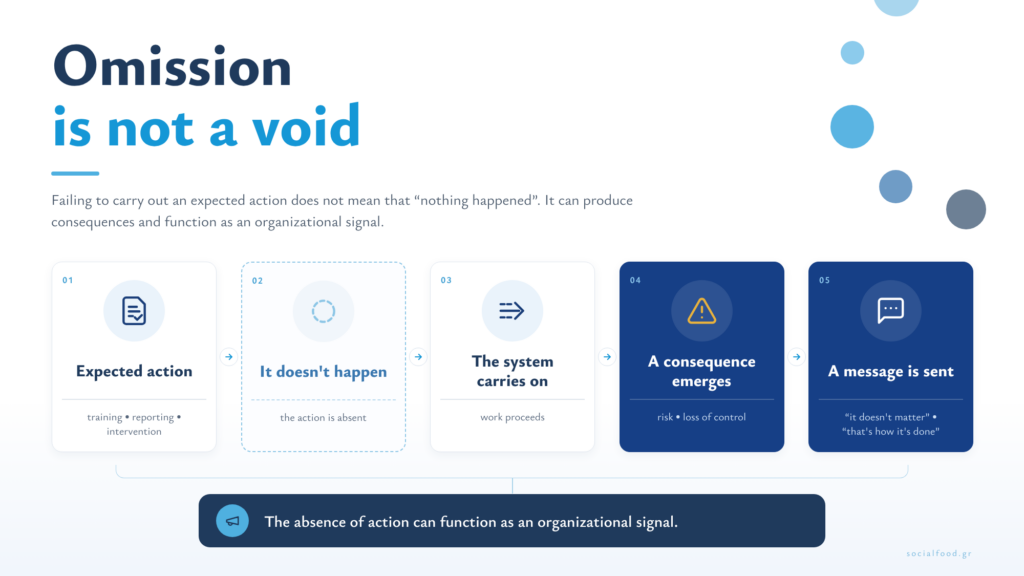
The absence of an expected action is not neutral: it may produce consequences and function as an organizational signal. Conceptual and bibliographic foundations: Spranca, Minsk & Baron (1991); Clarke (2014); Bonicalzi & De Caro (2024).
The phenomenon is, of course, not confined to training or document management. A scheduled verification that is systematically skipped can gradually convince those involved that verification is unnecessary. Beyond the obvious error of a disregarded deviation that may lead to a food safety incident, a deviation that goes uninvestigated can create the impression that investigation is pointless bureaucracy and, in this way, shape an organizational practice that affects the organization in the long term. A manager who systematically refuses to cooperate, yet continues to enjoy the unlimited support of top management, can establish a lack of cooperation, or injustice, as an acceptable pattern of behavior. Likewise, silence in the face of clearly unfair treatment does not simply mean that the injustice went unaddressed. It can communicate that the behavior in question is tolerated, that reporting it is futile, or even that organizational survival depends on accepting it. In this sense, absence can be transformed into an active act that produces rules, perceptions and behaviors, without anyone needing to have stated them explicitly. The scientific debate on Food Safety Culture offers a particularly useful background: the research team of De Boeck et al. (2017) has highlighted the relationship between the perceived food safety climate and employee behaviors, notably distinguishing their mandatory compliance from their additional, voluntary participation. Therefore, the environment in which someone is asked to follow a procedure matters substantially for their behavior. Every management choice, every act of tolerance and every repeated absence of intervention can contribute to shaping this environment. After all, we do not teach solely through the training sessions we organize or the policies we announce. We also teach through what we allow to happen without reaction.
The systemic dimension of the issue becomes more worrying when omissions recur without visible negative consequences. Rasmussen (1997) described how organizations, under the influence of operational and economic pressures, can gradually migrate toward the boundaries of acceptable and safe operation. We know, after all, that the absence of reports or visible failures does not necessarily provide reliable information about the actual condition of protective mechanisms and measures. On the contrary, it may allow their gradual erosion. Consider how easily the phrase “we’ve been doing it this way for years and nothing has ever happened” turns into an argument for not applying a procedure. When a deviation has no visible negative consequences, the impression may arise that there is no problem. Thus, the more the deviation is repeated, the more acceptable it becomes, until it is eventually established as routine practice.
Caution is needed, however: not all omissions are deliberate violations, nor does every deviation prove indifference. Lawton (1998) showed that procedural violations can be linked to different motives and operational conditions, even to employees’ legitimate intention to “get the job done”. Similarly, an unworkable procedure, a lack of resources or conflicting management demands can create an environment in which non-compliance is a predictable adaptation rather than simply an individual choice. That is why understanding the absence of action (omission) requires more than searching for the person who failed to act. It requires us to investigate what action was expected, why it was not carried out, who knew about it, how the organization responded and, above all, what behavior was reinforced through this experience.
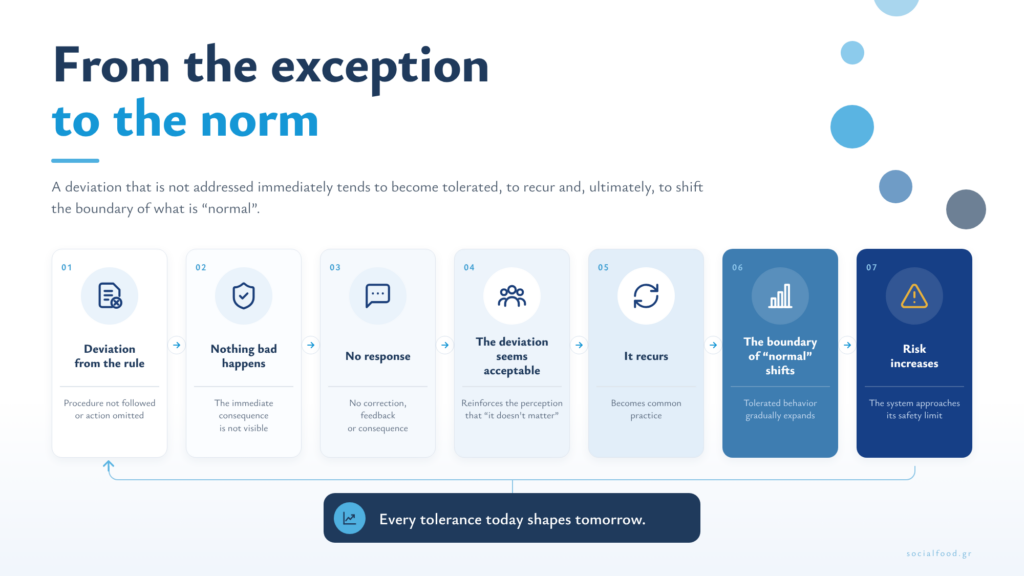
Repeated tolerance of deviations can turn an exception into established organizational practice, gradually shifting the boundaries of acceptable behavior and safety. Conceptual and bibliographic foundations: Lawton (1998); Rasmussen (1997); Morrison & Wears (2022).
Seen in this light, Food Safety Culture cannot be assessed solely through the existence of policies, procedures, training programs or completed records. The essential question is what happens when these tools meet real work: production pressure, uncertainty, conflicting priorities, human relationships and everyday management decisions. The recent systematic review by Wang et al. (2026) underlines the importance of reliable Food Safety Culture assessment and the difficulties that arise when measurement tools fail to adequately capture actual organizational conditions. Perhaps, then, we need to add a different dimension to the everyday observation and evaluation of how an FSMS operates: to examine not only what people do, but also what they learn from what does not get done. To look for the absences that have become normalized, the obligations that have lost their meaning, the silences that are taken as consent, and the management choices that, without declaring it, reshape the organization’s real priorities. Professional ethics and just accountability take on particular importance here: it is not enough to identify and assign responsibility for what was done; we must examine with equal seriousness what should have been done, taking into account the capacity to intervene, the proportionality of responsibility and the actual working conditions. Ultimately, the absence of action is not always inertia, and non-action does not mean absence of effect. An organization can teach without delivering training, establish rules without articulating them, and shape behaviors without demanding them. The question is whether it knows exactly what it is teaching.
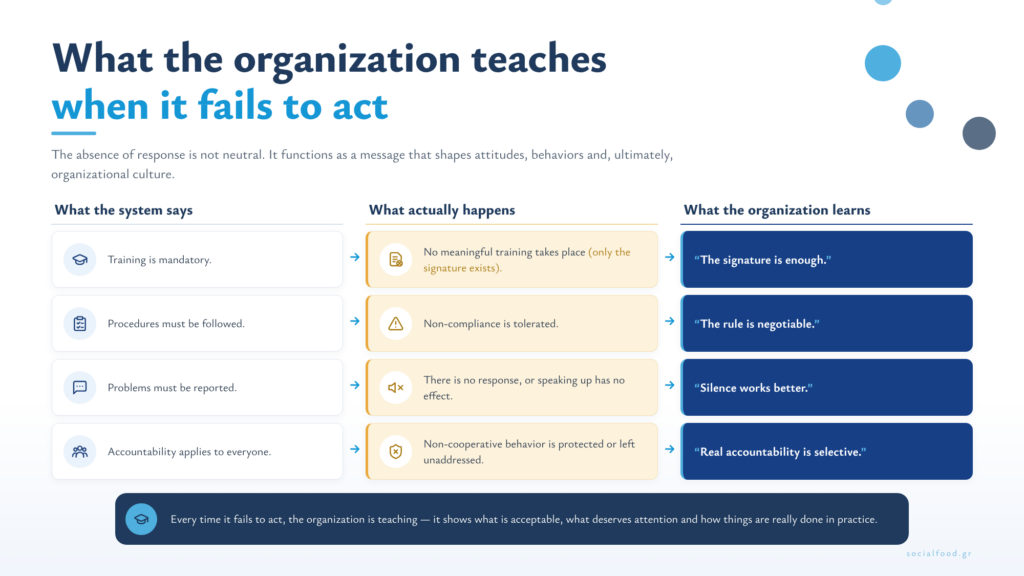
The gap between what a Food Safety Management System prescribes and what is actually tolerated shapes informal rules of behavior. The absence of meaningful training, management intervention, and consistent accountability may operate as a mechanism of organizational learning, influencing Food Safety Culture. Conceptual and bibliographic foundations: De Boeck et al. (2017); Lawton (1998); Rasmussen (1997).
References
- Bonicalzi, S., & De Caro, M. (2024). Agency without action: On responsibility for omissions. Argumenta, 10(1), 385–401. https://doi.org/10.14275/2465-2334/202200.bon
- Clarke, R. (2014). Omissions: Agency, metaphysics, and responsibility. Oxford University Press.
- De Boeck, E., Mortier, A. V., Jacxsens, L., Dequidt, L., & Vlerick, P. (2017). Towards an extended food safety culture model: Studying the moderating role of burnout and jobstress, the mediating role of food safety knowledge and motivation in the relation between food safety climate and food safety behavior. Trends in Food Science & Technology, 62, 202–214. https://doi.org/10.1016/j.tifs.2017.01.004
- Lawton, R. (1998). Not working to rule: Understanding procedural violations at work. Safety Science, 28(2), 77–95. https://doi.org/10.1016/S0925-7535(97)00073-8
- Manning, L., & Grant, J. H. (2025). Food safety management systems: The role of cognitive and cultural biases in determining what is ‘safe enough’. Trends in Food Science & Technology, 156, 104811. https://doi.org/10.1016/j.tifs.2024.104811
- Morrison, J. B., & Wears, R. L. (2022). Modeling Rasmussen’s dynamic modeling problem: Drift towards a boundary of safety. Cognition, Technology & Work, 24, 127–145. https://doi.org/10.1007/s10111-021-00668-x
- Rasmussen, J. (1997). Risk management in a dynamic society: A modelling problem. Safety Science, 27(2–3), 183–213. https://doi.org/10.1016/S0925-7535(97)00052-0
- Spranca, M., Minsk, E., & Baron, J. (1991). Omission and commission in judgment and choice. Journal of Experimental Social Psychology, 27(1), 76–105. https://doi.org/10.1016/0022-1031(91)90011-T
- Wang, K., Mirosa, M., Hou, Y., & Bremer, P. (2026). Measuring food safety culture: A systematic review of questionnaire dimensions and validation practices. Comprehensive Reviews in Food Science and Food Safety, 25, e70472. https://doi.org/10.1111/1541-4337.70472


