Food Safety and Culture: Has There Been a Misunderstanding?
From HACCP misconceptions to cultural maturity as an investment
- October 13, 2026
- Posted by: Thanasis Stathopoulos
- Category: Industrial
A Few Introductory Remarks
In the social sciences, there is a field known as Food Culture. It examines societies’ food-related customs, habits, traditions, and the broader cultural heritage surrounding food: whether as a social process and an outcome of agricultural production, as a meeting point for members of a society, or, ultimately, as an element of the way people grow and mature within a community.
In a completely different corner of life, within Food Safety Management Systems, we encounter a closely related term: Food Safety Culture. Put simply, the term describes the surrounding atmosphere in which Food Safety is designed, followed, verified, and reviewed. It describes how we approach both formal and informal requirements, the foresight with which we plan, our beliefs, the way we frame problems, and, ultimately, our practical applications on the factory floor.
Although a significant proportion of professionals confuse these two concepts, this article does not aspire to play the role of the classroom nerd correcting everyone else’s spelling and grammar. Still, that confusion tells us something.
Misconceptions surrounding Food Safety are not confined to technical matters. They are connected to the way organisations understand risk, responsibility, and the functioning of the system itself. Food Safety does not operate outside a social and organisational context: perceptions, customs, and established practices influence both employee behaviour and the way products are accepted by the market. In this sense, Food Safety is not only a technical matter; it is also a social construction.
Organisational Misconceptions
Within this living construction, misconceptions are reproduced that undermine the functioning of systems: that the Quality Department exists to “police” people, that HACCP is something done once, and that it is exclusively the responsibility of Quality Assurance. The logic of compliance often takes precedence over continuous improvement. Time for collecting, analysing, and reflecting on data remains limited, teams operate within a “safe zone”, and attention is directed towards confirming a loss of control rather than recognising indications and early signals.
Added to this are limited staff participation and the absence of meaningful cross-functional collaboration. Communication moves mainly from the top down, conflicting priorities and expectations are neither discussed openly nor designed jointly, and instructions often function as a “black box” for those expected to apply them. At the same time, disproportionate emphasis is placed on deviations, sanctions, and negative consequences, while positive examples, the recognition of desired behaviours, and tools from the social sciences that could support more effective training often remain underused.
Wallace, Mortimore and Motarjemi (2023) provide a useful bridge from current FSC misconceptions to the earlier misconceptions surrounding HACCP. The issue is not simply that “we do not know the definition properly”, but that we can understand the theory and still fail to make the conceptual leap towards a different way of organising and operating.
In the chapter “HACCP Misconceptions and Shortcomings” in Food Safety Management: A Practical Guide for the Food Industry, the authors begin with a familiar but still relevant paradox: although HACCP has been established internationally as a fundamental tool for Food Safety management, serious incidents, recalls, and foodborne outbreaks continue to occur. Their explanation is not that HACCP “doesn’t work”, but that it is very often neither understood nor applied as it was actually designed. The misconceptions they examine share a common core: they transform HACCP from a dynamic decision-making tool into a static administrative obligation. It may therefore be treated as something carried out for authorities or certification purposes, as a documentation exercise, as the responsibility of a single individual or an external consultant without any meaningful transfer of ownership to the business, as a stand-alone system disconnected from GMP, suppliers, audits, and other FSMS functions, or as a task that is completed once and then “finished”. The authors reverse this picture: HACCP is a continuous, multidisciplinary process of risk assessment and management that requires scientific and technical evidence, genuine knowledge of factory operations, and review whenever conditions change.
The same pattern can be seen in systematic implementation errors. Studies are carried out without the necessary scientific and technical knowledge; HACCP teams do not always have the competence to critically review the system; incident history and new knowledge are not systematically used; and analysis often stops at the factory gates, leaving out suppliers, transport, distribution, and the actual use of the product. In applying the principles, hazards are described vaguely; CCPs, PRPs, significant hazards, and control measures are confused; monitoring does not always cover all critical parameters; and corrective actions, validation, and verification may remain at a purely formal level, with validation and verification in particular often underestimated. Even HACCP maintenance is frequently reduced to a routine change-management exercise, whereas in reality every change in raw material, supplier, recipe, equipment, process, or market should trigger a documented consideration of its food-safety implications and the preventive measures required.
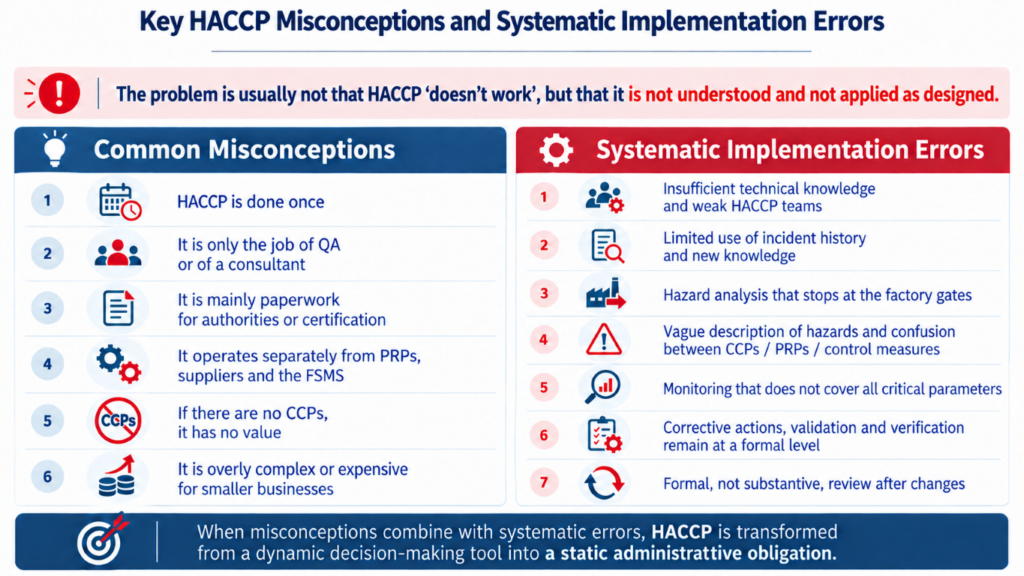
Schematic rendering based on Wallace, Mortimore & Motarjemi (2023), “HACCP Misconceptions and Shortcomings”.
It is precisely at this point that the contemporary discussion of Food Safety Culture becomes particularly interesting. Lues and colleagues (2026) open their review with the well-known phrase attributed to Peter Drucker: “Culture Eats Strategy for Breakfast”. The choice is not accidental. For years, the human and behavioural dimension was treated as a secondary determinant of quality and safety compared with systems, standards, and audits. Today it has emerged as a fundamental factor in Food Safety, precisely because serious incidents have occurred even in environments regarded as fully compliant. In other words, a factory that passes every audit is not necessarily safe. An external audit itself is only a “snapshot in time”, as highlighted by the research of Powell et al. (2023), among its other limitations. Compliance alone is not enough when the values, beliefs, and behaviours of the people applying the system do not support it in practice. Food Safety Culture matters precisely because it forces us to look at how systems function in the real life of the organisation: who speaks, who is heard, who decides, who accepts risk, when a deviation becomes considered “acceptable”, how much time managers have to analyse data, and how easily production pressure becomes the new normal.
The Relationship Between Protection, Production Pressure and Economic Performance: Safety VS Profit?
The relationship between safety (protection) and profit (production) is illustrated particularly well in James Reason’s (1997) model, as also presented by Andersen et al. (2023). The organisation moves between two extreme zones: excessive emphasis on protection at the expense of production may lead to economic suffocation, while excessive emphasis on production at the expense of protection may lead to catastrophe. Following an incident, management tends to move towards more conservative decisions and strengthen safety. Over time, however, the absence of further incidents and pressure for efficiency shift decisions back towards production, until another incident occurs, potentially more serious, as illustrated in the figure below by the progressively larger “bursts”. If this upwardly escalating trajectory continues, it may eventually end in a catastrophic condition.
The paradox is that success in Food Safety can easily become invisible. When no incidents occur, the impression may arise that the resources allocated to prevention are no longer quite so necessary. Yet the absence of incidents does not prove that risk has disappeared. It may simply mean that the system, the people, and the preventive safeguards are doing exactly the job for which they were put in place.
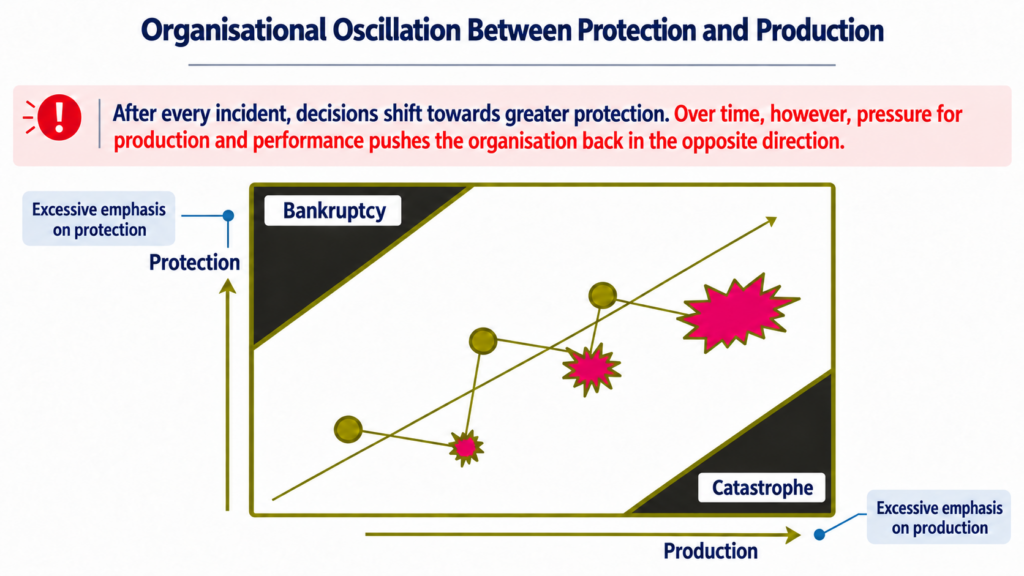
Adaptation of Reason’s (1997) Protection–Production model, as presented in Andersen et al. (2023).
Is Food Safety Culture Maturity an Investment?
The argument for investing in the maturation of Food Safety Culture has already appeared in the research literature and is linked to Cost of Quality theory. In Quality Is Free, Philip Crosby linked the maturity stages of an organisation’s quality culture to the cost of quality: from approximately 20% of sales at the least mature stage to around 2.5% at the most mature. The logic is simple: immaturity costs money; much of that cost simply appears later as rework, scrap, failures, complaints, recalls, lost time, and crisis management — after the problem has already occurred.
Lone Jespersen and her colleagues (2019) transferred this logic to Food Safety. They assessed FSC maturity across five multinational food companies and 21 of their plants, using questionnaires, analysis of 379 documents, and 42 interviews, and mapped the maturity stages onto Crosby’s percentages. On this basis, the five companies were estimated to be losing a total of approximately USD 1.14 billion annually in Cost of Poor Quality. Moving up one maturity stage would correspond to savings of approximately USD 0.43 billion, while dropping one stage would correspond to approximately USD 0.38 billion in additional cost. The authors themselves are, of course, cautious: these percentages function as an estimate of the scale at stake rather than as a ready-made ROI calculator.
The most important point in their approach is that FSC is not treated as a single intervention. It is a dynamic system linking organisational effectiveness, organisational norms, shared beliefs and group behaviour, as well as individual behaviour and intentions. Economic performance, therefore, is not expected to result from a single intervention, a training course, a campaign, or a new poster, but from the integration of these levels and the way they interact through an ongoing process of maturation. Maturity may mean better decision-making, greater adaptability, broader participation, stronger prevention and, ultimately, lower exposure to the cost of failure.
The first empirical step towards testing this hypothesis was taken by the Ghent University team (Spagnoli et al., 2024). The researchers measured FSC maturity and compared it with Cost of Quality data in five Belgian food manufacturing companies. Businesses with a more mature culture — and therefore fewer gaps across its dimensions (GFSI, 2026) — spent more on prevention and appraisal: training, validation, supplier evaluation, maintenance, controls, and inspections. This finding is consistent with contemporary Cost of Quality models, in which greater investment in prevention and appraisal is theoretically associated with lower failure costs and a lower overall cost of quality.
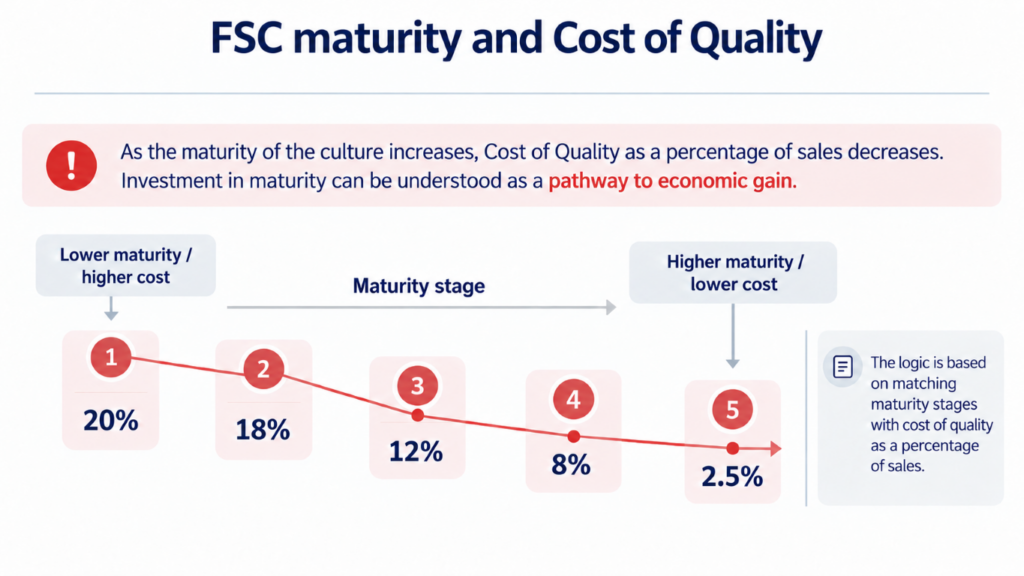
Adapted from Jespersen et al. (2019), based on the mapping of maturity stages to Crosby’s (1979) Cost of Quality.
The value of the study lies in showing that FSC maturity can be interpreted economically as a change in how resources are allocated. Instead of paying mainly after failure has occurred, the business shifts resources earlier, towards prevention, appraisal, learning, and control. This changes the way the issue is understood: FSC ceases to be merely another resource-demanding obligation and begins to be viewed as a potential route towards greater economic resilience.
Highlighting the two-way nature of this relationship, we could say that the connection between cultural maturity and investment is somewhat reminiscent of Schrödinger’s problem. It is not always clear whether a company invests more because it already has a mature culture or whether, conversely, the investment itself acts as a mechanism that gradually matures the culture. Most likely, both processes occur at the same time, in a cycle of mutual reinforcement. This is precisely one more reason not to search for the “one programme” that will fix culture, but instead to observe how resources, decisions, behaviours, and outcomes change together.
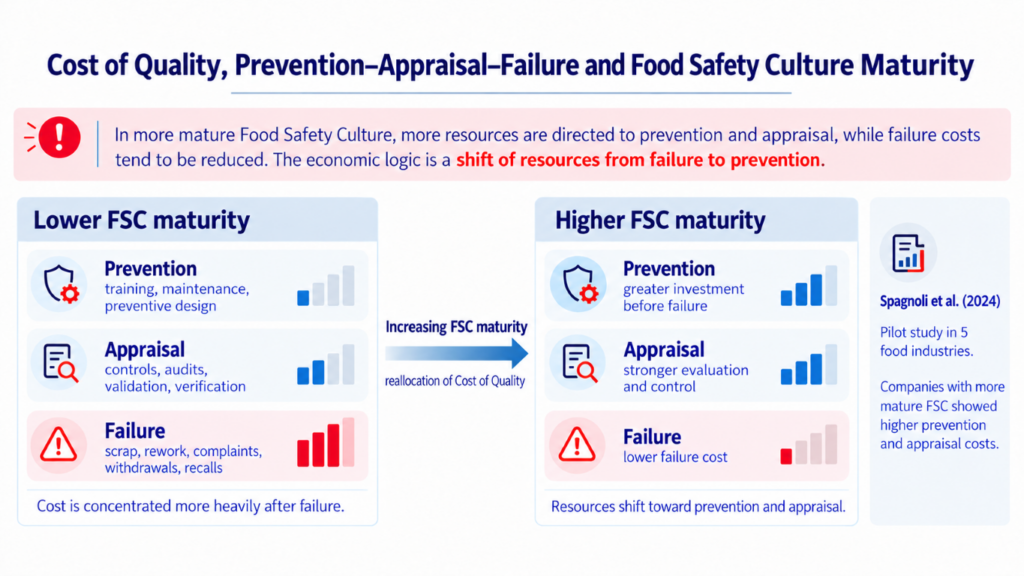
Schematic rendering of the findings of Spagnoli et al. (2024) regarding the relationship between FSC maturity and Prevention–Appraisal–Failure costs.
Closing the Misunderstanding
The same organisational logics that historically weakened HACCP (assigning responsibility to a few people, equating compliance with safety, treating data as evidence rather than as an opportunity for learning, and increasing production pressure when “everything is going well”) can very easily reappear today under the banner of Food Safety Culture. If that happens, we will simply have added one more programme to the system. If, instead, we view maturity as an investment in spreading throughout the organisation the capacity to notice earlier, discuss better, learn faster, and decide with greater foresight, then the economic question changes. “How much does culture cost us?” becomes “How much does it cost us not to mature it?” The real shift in resources is from failure to prevention, from reaction to learning, and from managing consequences to making better decisions before those consequences appear.
References
- Powell, D. A., Erdozain, S., Dodd, C., Costa, R., Morley, K., & Chapman, B. J. (2013). Audits and inspections are never enough: A critique to enhance food safety. Food Control, 30(2), 686–691. https://doi.org/10.1016/j.foodcont.2012.07.044
- Jespersen, L., Butts, J., Holler, G., Taylor, J., Harlan, D., Griffiths, M., & Wallace, C. A. (2019). The impact of maturing food safety culture and a pathway to economic gain. Food Control, 98, 367–379. https://doi.org/10.1016/j.foodcont.2018.11.041
- Andersen, V., Lelieveld, H., & Motarjemi, Y. (Eds.). (2023). Food safety management: A practical guide for the food industry (2nd ed.). Academic Press.
- Wallace, C. A., Mortimore, S., & Motarjemi, Y. (2023). HACCP misconceptions and shortcomings. In V. Andersen, H. Lelieveld, & Y. Motarjemi (Eds.), Food safety management: A practical guide for the food industry (2nd ed., pp. 819–832). Academic Press. https://doi.org/10.1016/B978-0-12-820013-1.00051-6
- Spagnoli, P., Defalchidu, L., Vlerick, P., & Jacxsens, L. (2024). The relationship between food safety culture maturity and cost of quality: An empirical pilot study in the food industry. Foods, 13(4), 571. https://doi.org/10.3390/foods13040571
- Global Food Safety Initiative. (2026). A culture of food safety: Position paper from the Global Food Safety Initiative (GFSI) (Version 2.0). The Consumer Goods Forum.
- Lues, R., Jonker, J., Visser, M., & Skweyiya, N. (2026). Turn-key protocols for food safety culture improvement: A narrative on theory and best practice. Foods, 15, 2540. https://doi.org/10.3390/foods15142540


